
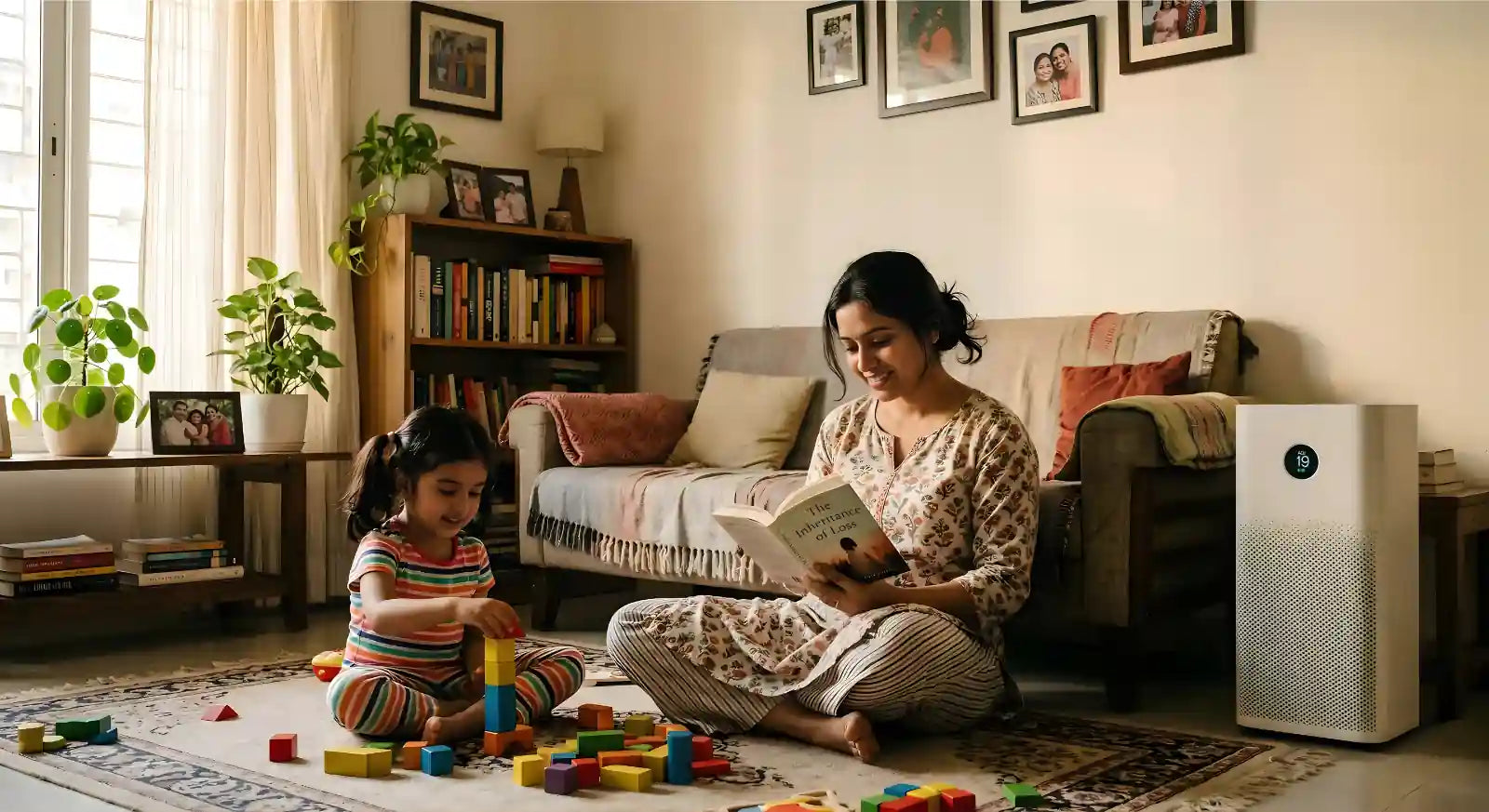
You have been thinking about buying an air purifier for a while now. Maybe your city hit AQI 300 last winter and you got an alert on your phone that made you genuinely uncomfortable. Maybe your child has been sneezing constantly and the paediatrician mentioned allergies. Maybe you just moved into a new flat and the air smells faintly of paint and something you cannot quite identify.
Whatever brought you here, you are probably now looking at a list of air purifiers ranging from Rs 4,000 to Rs 80,000, all claiming to clean your air, all showing impressive-sounding specifications, and none of them telling you which one will actually make a difference in your specific home.
This guide will.
Why Most Air Purifiers Sold in India Disappoint People
Let us start with the uncomfortable truth. The majority of air purifiers sold on Indian e-commerce platforms between Rs 4,000 and Rs 15,000 will not meaningfully improve the air quality in a typical Indian home. Not because air purification does not work. It absolutely does. But because the products in that price range are almost universally undersized, underpowered, and built with filters that degrade quickly in Indian air conditions.
Here is how it happens. You buy a purifier rated for 400 square feet. Your living room is 250 square feet, so you think you are covered. But the 400 square feet claim was calculated in a laboratory with a 2.5-metre ceiling, no furniture, and no occupants. Your living room has a 3-metre ceiling, sofas, curtains, a television unit, rugs, and actual people breathing in it. In real conditions, that purifier is working at the limit of its capacity from the moment you switch it on.
Add to that the fact that Indian urban air quality, especially in Delhi, Mumbai, Bangalore, Pune, and Hyderabad, is significantly worse than the conditions most purifiers are tested in globally, and the gap between what the box claims and what the product delivers becomes very large.
The One Number That Actually Matters: CADR
Every air purifier specification you will see mentions filter type, coverage area, noise levels, energy consumption, and usually a dozen other figures. Almost all of them are marketing. The one number that is independently verified and actually predictive of real-world performance is CADR, or Clean Air Delivery Rate.
CADR measures how much clean air the purifier produces per hour. It is tested by third-party laboratories against standardised pollutants. A higher CADR means the purifier cleans more air per hour.
To know what CADR you need for a room in your home, you need two things: the floor area and the ceiling height. Multiply them together to get the room volume, then multiply that by 5. That is the CADR you need to properly clean the air in that room five times per hour, which is the minimum standard for a space where people spend significant time.
For a typical Indian apartment bedroom, roughly 12 by 10 feet with a 9-foot ceiling, that works out to a room volume of about 30 cubic metres and a required CADR of 150 m³/h. For a living room of 20 by 15 feet with the same ceiling height, you need roughly 250 m³/h. Many purifiers in the Rs 8,000 to Rs 12,000 bracket claim to cover these spaces but deliver CADR figures of 80 to 120 m³/h. That is genuinely not enough.
When you are comparing purifiers, ignore the coverage area claim on the box. Find the CADR figure, calculate what you need for your specific room, and buy accordingly.
HEPA Filters: What the Grade Means for Your Family
You will see the word HEPA on virtually every air purifier sold in India. What most products do not tell you is that HEPA is a category, not a standard, and the difference between a low-grade HEPA filter and a high-grade one is significant.
HEPA filters are graded from H10 to H14. H10 captures about 85% of particles. H13 captures 99.97% of particles, including PM2.5, which is the fine particulate matter that comes from vehicle exhaust, construction dust, and burning that dominates Indian urban air. H14 captures 99.995%.
For a home in an Indian metro city, you want H13 as a minimum. Anything marketed as simply "true HEPA" or "HEPA filter" without specifying a grade is almost certainly H10 or H11. At 85% capture efficiency, it is leaving a meaningful proportion of the most harmful particles in your air.
If you have a child, an elderly parent, or anyone in your household with asthma, chronic respiratory issues, or allergies, H13 is not a nice-to-have. It is the specification that makes the actual difference.
The Pollution Season Reality for Indian Homes
If you live in Delhi NCR, the period between October and January is in a different category from the rest of the year. AQI readings above 300 are not unusual. Above 400 happens regularly. At those levels, outdoor air is classified as hazardous, and the recommendation from public health authorities is to stay indoors.
The problem is that staying indoors only protects you if your indoor air is actually cleaner than the air outside. In a sealed flat with windows and doors shut and no air purification running, indoor AQI tracks outdoor AQI fairly closely, lagging by a few hours as pollution seeps through gaps in window frames, ventilation openings, and every time a door is opened.
A properly sized and functioning air purifier changes this equation entirely. A good H13 HEPA unit running in a bedroom with the door closed can bring indoor AQI from 200-plus down to below 30 within 30 to 45 minutes and maintain it there overnight. That is the difference between your family sleeping in hazardous air and sleeping in clean air. It is also the difference your child's lungs experience for those eight hours every night.
This is why sizing matters so much. An undersized purifier running in a bedroom during a high-pollution night in Delhi will reduce AQI somewhat but may not reach safe levels. A correctly sized unit will get there and hold it.
What About VOCs? The Pollution Type Nobody Talks About
Particulate matter gets all the attention because AQI is primarily a measure of particles. But the air in your home contains another class of pollutants that HEPA filters do not capture at all: volatile organic compounds, or VOCs.
VOCs are gases released by everyday household items. New furniture, especially the flat-pack variety with pressed wood and adhesives, releases formaldehyde for months after purchase. Fresh paint, cleaning products, air fresheners, scented candles, cooking fumes, and synthetic carpets all release VOCs continuously. If your flat smells of "new home" for weeks after moving in, that smell is VOCs.
Exposure to VOCs at the levels common in newly furnished Indian flats is associated with headaches, eye and throat irritation, dizziness, and in higher concentrations, more serious health effects. Children and pregnant women are particularly sensitive.
The solution is an activated carbon filter alongside your HEPA filter. Activated carbon adsorbs gases and is the only practical way to address VOCs in a home setting. When buying a purifier, check whether the carbon layer is a thin mesh (minimally effective) or a thick, granular carbon bed (genuinely effective). Most consumer products in India use the thin mesh version. It is better than nothing but not by much.
How Many Purifiers Does Your Home Actually Need
One of the most common mistakes Indian buyers make is purchasing a single purifier and placing it in the living room, assuming it will improve air quality across the flat. It will not. Air purifiers clean the air in the room they are placed in. A closed bedroom door means the purifier in the living room has no effect whatsoever on the air your family sleeps in.
The practical approach for most Indian apartments is:
One unit in the master bedroom, running continuously on a low-to-medium setting overnight. This is where your family spends the most consecutive hours and where clean air has the greatest impact on health and sleep quality.
One unit in any room where a child sleeps or spends significant time, sized for that specific room.
One unit in the living area if you have the budget, particularly if you cook in an open kitchen where cooking fumes circulate freely into the main living space.
You do not need the most expensive unit in every room. The bedroom unit where your child sleeps warrants the best H13 HEPA unit you can afford. Supplementary rooms can use a well-specified but more modest unit.
The Filter Replacement Reality
Every air purifier filter has a finite life. HEPA filters in Indian homes, where particulate levels are significantly higher than the testing conditions used by most manufacturers, often need replacement more frequently than the packaging suggests.
A filter rated for 12 months in European conditions may last 6 to 8 months in Delhi during pollution season. Running a purifier on an old, saturated filter does not just reduce effectiveness. It can actually restrict airflow to the point where the purifier is working harder, using more electricity, and cleaning less air.
Before buying, check the replacement filter cost and availability. Some purifier brands, particularly imported ones, have replacement filters that are genuinely difficult to source in India or are priced at Rs 3,000 to Rs 6,000 per replacement. That cost, paid every six to eight months for each unit, should be part of your total cost of ownership calculation.
What to Ignore When Buying
Ionisers and plasma technology. Several purifiers in India are marketed with ioniser or plasma wave technology as a key feature. Some ionisers produce trace amounts of ozone as a byproduct, which is itself an indoor air pollutant. The US Environmental Protection Agency has recommended caution around ioniser-based air cleaners for this reason. A good H13 HEPA filter with activated carbon is more effective and does not carry this concern.
Smart features as a primary consideration. Wi-Fi connectivity, app control, and voice assistant integration are pleasant extras. They do not affect how well the purifier cleans your air. Do not pay a significant premium for smart features at the expense of filtration quality or CADR.
Coverage area claims. As discussed, these are manufacturer estimates made under laboratory conditions. They are not reliable indicators of performance in your specific home. Calculate CADR requirements for your rooms and match them to the unit's independently verified CADR figure.
Lifetime filters. Some purifiers are marketed with washable or lifetime HEPA filters. Washable HEPA filters are categorically less effective than replaceable ones and cannot maintain H13 filtration efficiency after washing. There is no such thing as a genuinely effective lifetime HEPA filter.
What Good Air Actually Feels Like
This might sound obvious, but it is worth saying because many people who have lived with poor indoor air quality for years have forgotten what the alternative feels like.
Good indoor air, in the AQI 20 to 35 range, has no smell. It does not feel heavy. You do not notice it, which is exactly the point. Waking up in a room where the purifier has been running overnight, during a high-pollution Delhi winter, should feel no different from waking up on a clear monsoon morning. Your nose and throat should not be dry. You should not have a low-grade headache before your first cup of chai. Your child should not be sneezing before they get to school.
If any of those things are currently your normal, your indoor air is the likely cause, and it is fixable.
A Practical Summary Before You Buy
Calculate the CADR you need for each room you want to cover. Do not rely on coverage area claims.
Insist on H13 HEPA. Check the filter grade, not just the HEPA label.
Look for a substantial activated carbon stage if VOCs are a concern, which they are in any newly furnished home.
Check replacement filter cost and availability in India before committing to a brand.
Size the bedroom first. That is where the hours accumulate and where clean air matters most.
Buy one good unit for the most important room rather than two inadequate ones.
KyoAir supplies H13 HEPA air purifiers for Indian homes, with direct-to-home delivery across metro cities and a filter replacement programme so your unit keeps Home working as it should. Find the right unit for your home at kyoair.com

Share: