
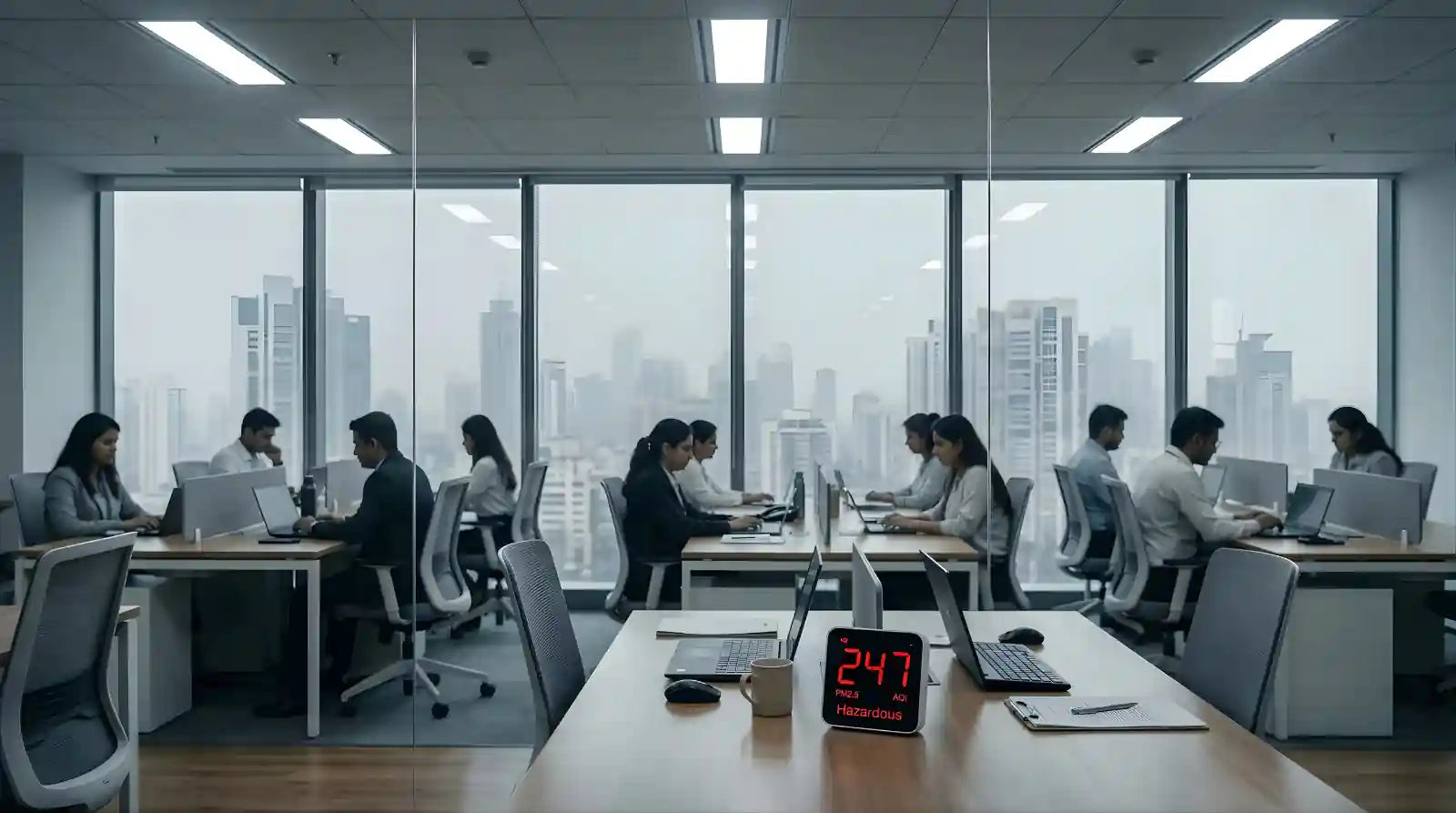
Your employees arrive at the office, settle in, and within a few hours the complaints start. Headaches. Fatigue. A general feeling of heaviness that no amount of coffee seems to fix. The afternoon slump hits harder than it should. By 3pm, half the floor looks like it is running on empty.
You have probably assumed this is a productivity issue, a motivation issue, or simply the nature of long working hours. In most cases, it is none of those things. It is the air.
The Office Air Problem Nobody Talks About
Indoor air quality in sealed corporate environments across Indian metro cities is significantly worse than most facilities teams realize. According to the World Health Organization, indoor air can be up to five times more polluted than outdoor air. In a sealed, air-conditioned office, that figure is not an outlier. It is standard.
Here is why. Your air conditioning system cools and recirculates the same indoor air continuously. It does not filter fine particulate matter, does not remove volatile organic compounds (VOCs), and does not bring in meaningful amounts of fresh oxygen. It simply moves the same air around the room, hour after hour, day after day.
As a result, everything your employees exhale, every VOC released by office furniture, carpets, cleaning products, printer ink, and building materials, and every particle of dust and allergen that enters the building, all of it accumulates in that sealed loop.
What Is Actually in Your Office Air
PM2.5 and PM10 particulates. These are fine particles smaller than 2.5 microns in diameter. They are invisible to the naked eye and penetrate deep into the respiratory system. Sources include vehicle exhaust entering through ventilation, construction dust, and particles shed from office materials. In Delhi, Mumbai, and Bangalore, outdoor PM2.5 regularly exceeds safe limits. Your sealed office concentrates that further.
Volatile Organic Compounds. VOCs are gases emitted by a wide range of common office materials. New furniture, carpets, adhesives, paints, cleaning sprays, whiteboard markers, and even printed documents release VOCs into the air continuously. Symptoms of low-level VOC exposure include headaches, dizziness, difficulty concentrating, and eye irritation. These are symptoms your employees almost certainly experience regularly.
Carbon dioxide. As your team breathes, CO2 levels in the room rise. In a sealed space without adequate fresh air exchange, CO2 can reach levels that noticeably impair cognitive function. Studies have shown that elevated CO2 in meeting rooms reduces decision-making ability and attention span measurably. If your team leaves a two-hour meeting feeling inexplicably tired, CO2 is a likely contributor.
Allergens: Dust mites, mold spores, and pollen all circulate through office HVAC systems. For employees with allergies or asthma, a sealed office environment can trigger symptoms that are mistaken for frequent colds or general illness.
Why Indian Offices Are Particularly Affected
Indian metro cities face a compounding challenge that most Western air quality research does not fully capture. Outdoor air quality in Delhi, Mumbai, Bangalore, Hyderabad, and Pune is already significantly worse than global benchmarks for much of the year. The period from October through January regularly sees AQI readings that would be considered dangerous in any international framework.
When employees travel to work through this outdoor air and then spend nine hours in a sealed office that recirculates indoor pollutants, the cumulative exposure is substantial. The office environment does not protect them from poor outdoor air. It simply replaces outdoor pollution with a different cocktail of indoor pollutants.
The increasingly common practice of building sealed, fully air-conditioned offices to keep out heat and noise has inadvertently created environments where air quality receives no natural dilution from fresh outdoor air whatsoever.
The Symptoms Your HR Team Keeps Seeing
Poor indoor air quality does not announce itself. It does not smell, it is not visible, and it does not trigger an obvious alert. Instead, it creates a pattern of low-level symptoms that get attributed to other causes.
Frequent respiratory complaints. Employees who were not previously prone to allergies begin experiencing persistent sniffles, a scratchy throat, or a dry cough that clears up at the weekend. This pattern, symptoms that appear during the working week and resolve during time away from the office, is a recognized indicator of indoor air quality problems. It even has a clinical name: sick building syndrome.
High sick leave during pollution season. If your absenteeism data shows a consistent spike between October and January, poor indoor air is very likely a factor. The combination of elevated outdoor AQI and sealed indoor environments creates conditions where respiratory illness spreads rapidly and recovery is slower.
Afternoon productivity collapse. This is perhaps the most commercially significant symptom. Elevated CO2 and particulate matter both have documented effects on cognitive performance. If your floor looks alert in the morning and visibly depleted by 2pm, the air in the room deserves investigation before you look at workload or morale.
Employee complaints that feel unspecific. "The office feels stuffy." "I always leave with a headache." "I feel fine at home but exhausted here." These are not vague complaints. They are consistent descriptions of poor indoor air quality.
What a Healthy Office Air Quality Reading Looks Like
The Air Quality Index (AQI) provides a standardized measure of indoor air quality. An AQI reading below 50 is considered good. Between 50 and 100 is moderate. Above 100 begins to affect sensitive groups, and above 150 affects everyone.
In unseated corporate offices measured during normal working hours across Indian metro cities, AQI readings between 150 and 300 are common. In enclosed meeting rooms during a two-hour session, readings frequently exceed 200.
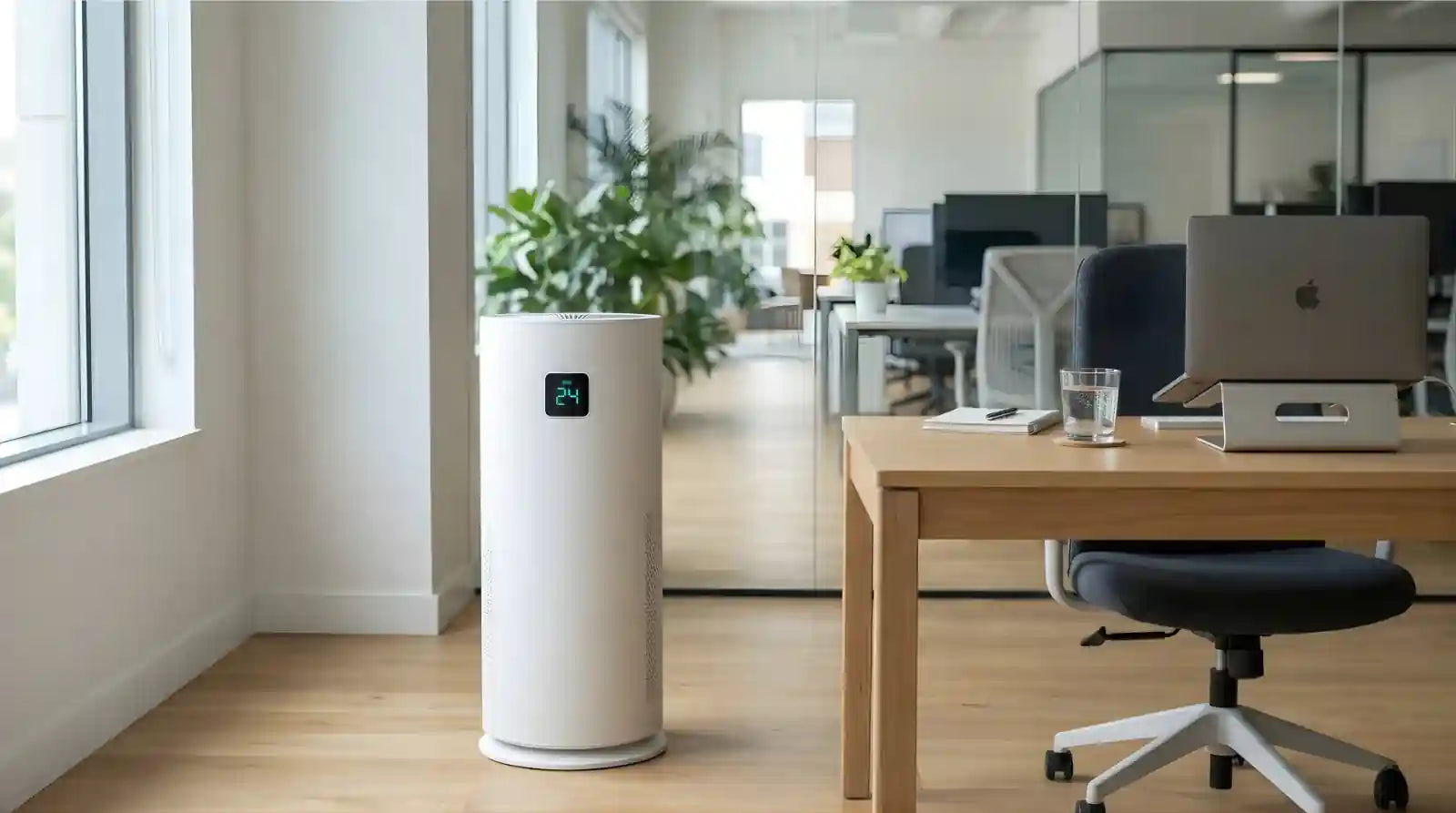
An office with properly specified and maintained air purification can consistently achieve AQI readings below 30. That difference, between 200 and 30 in the same physical space, is not marginal. It is the difference between an environment that is actively harming your team and one that is genuinely safe.
What You Can Do About It
The starting point is measurement. You cannot manage what you cannot see, and most offices have never measured their indoor AQI at all. A professional indoor air audit maps your space zone by zone, identifies the highest-risk areas such as sealed meeting rooms, enclosed cabins, and high-occupancy floors, and gives you a factual baseline.
From there, the solution involves specifying air purification equipment correctly. This means using the actual CADR (Clean Air Delivery Rate) relative to your room volumes, not the inflated floor-area claims on consumer packaging. It means choosing medical-grade H13 HEPA filtration, which removes 99.99% of particles including PM2.5, allergens, and airborne pathogens. And it means pairing that with an ongoing service model that ensures filters are replaced on schedule rather than forgotten.
Consumer purifiers bought from retail are almost universally insufficient for corporate environments. They are sized for single rooms in residential settings, they have no enterprise service model, and they have no data output that lets you verify they are working. For a corporate deployment to be credible, it needs to produce numbers. Specifically, it needs to produce AQI readings by zone that your HR and facilities team can review and present.
The Bottom Line
Your employees are spending nine hours a day breathing air that, in most sealed Indian offices, contains levels of PM2.5, VOCs, and CO2 that would not be acceptable in any other context. The headaches, the afternoon fatigue, the spike in sick leave during pollution season, and the persistent respiratory complaints are not unrelated grievances. They are consistent symptoms of a single, measurable, solvable problem.
The good news is that indoor air quality is one of the few workplace health variables that can be improved dramatically with a specific, verifiable intervention. Unlike stress, ergonomics, or commute times, bad air has a number, and that number can be changed.
If your team has been complaining about the office air and you have not yet measured it, that is the only place to start.
KyoAir offers free indoor air audits for corporate offices across Mumbai, Delhi NCR, Bangalore, Hyderabad, and Pune. Book yours at kyoair.com.
Share: